
According to UNICEF , at least 230 million women and girls worldwide had undergone genital mutilation in 2024.
Female genital mutilation has been documented in over 90
countries. This practice is carried out in 31 African countries as well as in some
countries in Southeast Asia and the Middle East.
According to an estimate by the Federal Ministry for Women’s Affairs, as of the end of 2024, there were approximately 123,000 women and girls living in Germany who had already been affected or were considered at risk. Of these, about 86,500 adult women had already undergone some form of genital mutilation. In addition, approximately 11,100 underage
girls could potentially be affected, and up to 25,000 more girls may be at risk.
Many families here also adhere to the traditional practice and have their daughters
circumcised, usually during vacations in their country of origin or abroad.
Female genital mutilation refers to all procedures in which the genitals of girls and women are injured, partially or completely removed. According to the definition of the World Health Organization (WHO), there are four different forms of female genital mutilation:
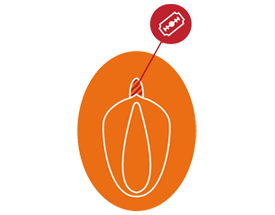
The clitoris and/or the clitoral hood are partially or completely removed.
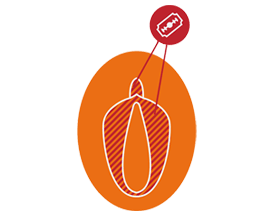
The clitoris and the labia minora are partially or completely removed, with or without removal of the labia majora.
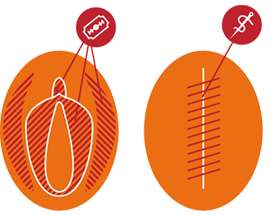
The labia minora and/or labia majora are partially or completely removed, with or without removal of the clitoris. By stapling or suturing the labia together, the vaginal opening is narrowed, resulting in a covering, scarred skin closure.

This includes all other harmful procedures that injure the female genitalia and serve no medical purpose, such as pricking, piercing, cutting, scraping, burning, or caustic treatment.
Approximately 80 percent of girls and women worldwide have undergone Type I or II circumcision, and about 15% have undergone Type III. Type III is also known as “Pharaonic circumcision” and is the most severe form. The remaining vaginal opening is often as tiny as a grain of rice. As a result, urine and menstrual blood can only drain drop by drop, which can lead to blood pooling. When using the restroom, these girls and women sometimes take up to half an hour to urinate. For sexual intercourse and childbirth, the vagina often has to be reopened (defibulation).
Female genital mutilation is practiced in 31 African countries:
Egypt, Ethiopia,
Benin, Burkina Faso, Djibouti, Ivory Coast, Eritrea, Gambia, Ghana, Guinea, Guinea-Bissau,
Cameroon, Kenya, Congo, Liberia, Malawi, Mali, Mauritania, Niger, Nigeria, Zambia, Senegal, Sierra
Leone, Somalia, Sudan, South Sudan, Tanzania, Togo, Chad, Uganda, Central African
Republic.
This practice also occurs:
in Southeast Asia (India, Indonesia, Malaysia,
Pakistan, Sri Lanka, Thailand), in the Middle East (Iraq, Iran, Yemen, Oman, United Arab
Emirates), and in the Russian republic of Dagestan.

The prevalence and distribution vary greatly from country to country. There are countries,
where the prevalence is very high, at over 90 percent: Guinea (99%), Djibouti (98%),
Somalia (98%), Egypt (97%), and Mali (92%). This means that in these countries, nearly all girls and
women are affected. In other countries, female genital mutilation is practiced only in certain
parts of the country or among specific ethnic groups.
The type of mutilation also varies
depending on the country and ethnic group. Type III (infibulation) occurs primarily in Djibouti,
Eritrea, Yemen, Oman, Somalia, Sudan, South Sudan, and parts of Mali.
In Southeast Asia,
Type I or Type IV FGM is most commonly performed.
Due to immigration and displacement,
FGM is also an issue in Europe and Germany.
Most girls are between 4 and 14 years old when they are circumcised. However, it also happens that
the procedure is performed just a few days after birth. This depends on
the specific ethnic group. There are ethnic groups in which women are not circumcised until before marriage or after the birth of their
first child. This often happens when an uncircumcised woman marries a man from
an ethnic group that practices female genital mutilation.
The trend, however, is to circumcise girls as early as possible. The reason for this is that female genital mutilation is now banned in many countries, and younger girls are less able to resist it.
In the villages, female genital mutilation is traditionally performed by a female practitioner. This is usually done without anesthesia and under unsanitary conditions. The practitioner uses a sharp object as a tool: a razor blade, a knife, a piece of broken glass, or a can lid. The tools are usually not sterile and are often used on multiple girls. As a result, serious infections can occur, and HIV/AIDS can be transmitted.
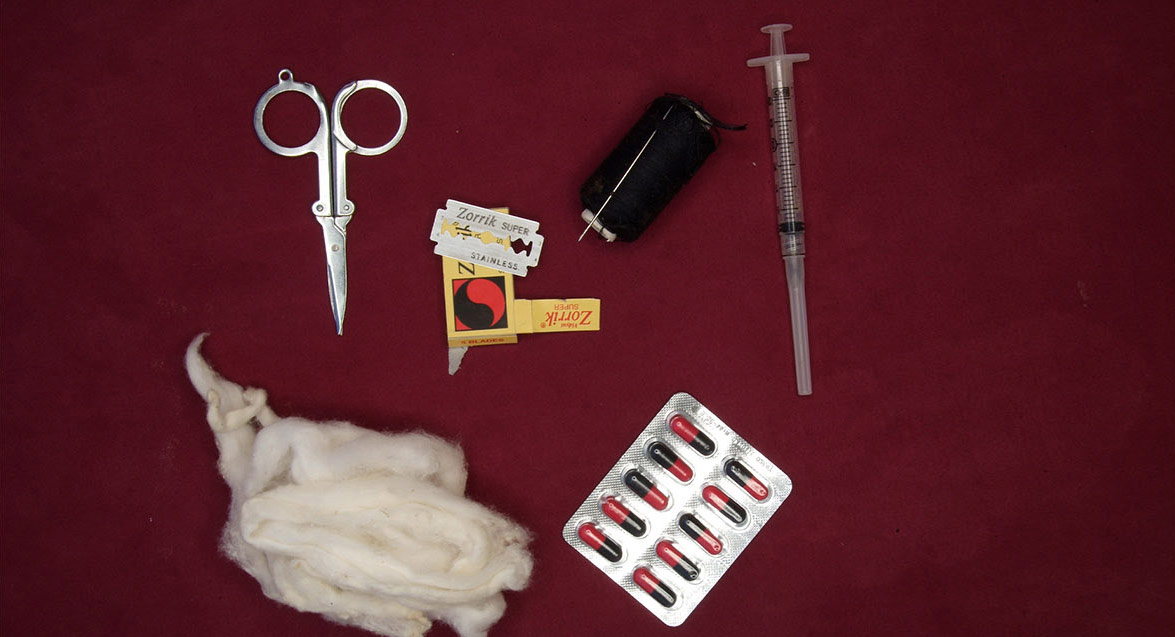
The girls often do not know beforehand what to expect during the procedure or what the consequences of the
circumcision are. Since female genital circumcision is a taboo subject, the girls learn nothing about it, for example, from an older sister. Often, girls who have already undergone the procedure have repressed the
horrible experience. In some ethnic groups, girls are promised a beautiful celebration;
they receive gifts and are accepted into the community of adult women, so that
they look forward to their circumcision.
Their mothers urge the girls to
be brave and not bring shame upon them. Often, during the procedure, they are held down by their own
mother, aunts, and female neighbors. The girls suffer unimaginable pain during the procedure,
which can lead to loss of consciousness, and are often traumatized afterward. Men are not present during
the circumcision. As a result, they often have no idea what the procedure means for the girls
and women or what its consequences are.
The profession of female circumciser is highly respected in African society. It provides the
women who practice it with their own income and, thus, a measure of independence. Often, they support their families through their work. Mothers pass on the profession of female circumciser to their daughters.
The
female circumcisers have no anatomical knowledge of the female body. As a result, during the procedure, they often injure other organs, such as the urethra. Older circumcisers also suffer from deteriorating vision.
To convince as many circumcisers as possible to give up their practice, they must first be educated about the fact that circumcision is harmful to health and can even lead to the death of the girls. Many female circumcisers are not aware of this
connection. At the same time, alternative sources of income must be created for former female circumcisers.
For this reason, projects retrain female circumcisers as seamstresses or give them the opportunity to run a small chicken farm.
Female genital mutilation deprives girls of their physical integrity and
often causes them to suffer lifelong consequences. The procedure is irreversible. It has a negative impact on the physical and mental health of the affected girls and women, as well as on their sexuality, and can even lead to death.
According to estimates by the
World Health Organization (WHO), 10 percent of those affected die from the acute consequences and 25 percent
from the long-term effects. In the most severe form of female genital mutilation, known as
infibulation (Type III), the mortality rate is 30 percent.
Girls and women
who have undergone Type III (infibulation) FGM, blood stasis frequently occurs during menstruation.
A long-term consequence of this can be infertility. Pus often accumulates at the scar site in the form of abscesses, cysts, and growths, which impair urination, sexual intercourse, and the course of childbirth.
Complications frequently occur during pregnancy and childbirth.
Because the scar tissue in the vagina is less elastic, labor may stall, which
can lead to the death of both mother and child. Another consequence may be incontinence, which can result from the formation of
fistulas. In addition to the health effects, both incontinence and
infertility can impair the social lives of affected women and lead to their social
exclusion.
The impact on sexuality varies greatly among affected women.
This is because every woman experiences sexuality differently, and many factors are responsible for a fulfilling sexual life.
Some affected women experience pain during sexual intercourse and a reduced sense of pleasure.
Other women do experience pleasure and are satisfied with their sexuality.
In addition to
physical symptoms, the procedure can also have psychological consequences. For many girls and
women, FGM constitutes emotional trauma. It can lead to depression, eating disorders, sleep disturbances, and
difficulty concentrating.
The reasons why girls undergo genital mutilation are varied and very
diverse. This depends on the country and ethnic group in question. One reason is that it is a
tradition that is upheld and passed on to the next generation. Anyone who opposes it is excluded from the community.
Circumcision is considered a prerequisite
for women to find a husband and get married. This is an argument that is repeatedly cited, especially by
mothers and grandmothers. Through marriage, women and their families are
socially and economically secure. For uncircumcised, unmarried women, it is very
difficult to live independently.
Society expects women to fulfill the roles of wife
and mother. Female genital mutilation is intended to control and restrict a woman’s sexuality;
a lack of sexual interest is supposed to guarantee virginity until marriage and, thereafter, the woman’s fidelity.
In many African societies, the external female genitalia are
circumcised because they are considered dirty and ugly and do not conform to the ideal of beauty.
Due to a lack of biological and medical knowledge, it is often assumed that
genital circumcision increases a woman’s fertility and facilitates pregnancy and childbirth.
However, the opposite is true!
There are societies in which circumcision is a
rite of passage marking the transition to adulthood. It celebrates the transition from child to woman.
Often, a festival is held in this context for the girls who are circumcised.
Another reason frequently cited for female genital circumcision is that the
religion requires it. However, the circumcision of girls and women already existed in pre-Christian
and pre-Islamic times. It is not mentioned in the Bible or the Quran. Nor does belonging to a specific religion play a role: Female genital circumcision is practiced among Christians, Muslims, and followers of traditional religions.
To highlight the serious consequences and avoid giving the impression that the issue is being downplayed,
the term “genital mutilation” is often used. Furthermore, the term
“circumcision” might suggest that female genital cutting is similar to male circumcision. However,
that is not the case!
Most affected women do not want to be referred to as “mutilated”
and therefore prefer the term “genital circumcision.” In counseling work with affected
women, the term “genital circumcision” is therefore used. Thus, the choice of term always depends on the situation, the
context, and the target audience.
Internationally,
the term “female genital mutilation” and its abbreviation FGM (mutilation =
mutilation) are predominant. In addition, the English term “female genital cutting” (FGC) is used for
circumcision.

Through our newsletter, we provide you with regular, up-to-date information on the topic of female genital mutilation and our work. The newsletter is published quarterly and is sent free of charge as a PDF file via email.